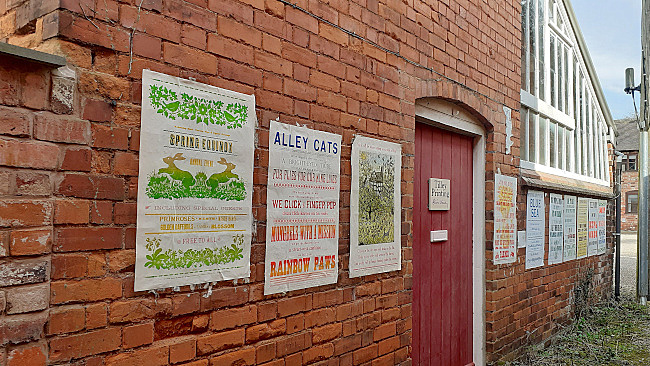
Alleys, Rows and Yards
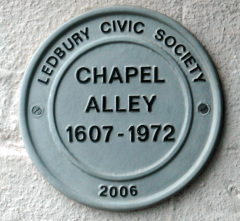
Walking about Ledbury you may notice plaques recording the location of former alleys, rows and yards. Some are easy to spot, others difficult. They were set up by the Ledbury & District Society Trust ( now the Ledbury Civic Society ) mainly in 1993 with a few later, notably Chapel Alley in 2006.
They mark the location of historic features of old Ledbury at that time about which little is known today.
To find out what a plaque commemorates I have used Tilley's Almanack, the 1910 survey and census returns.
First published in 1897 Tilley's Almanack was produced annually by Luke Tilley and which, from 1904, listed all the streets of Ledbury with the names of the occupants of each premises. House numbers were added after 1908. Where there is a side alley, which continued using the main street house numbering, he records this fact but not the alley's details.
Here is an example from the 1908 edition:
Homend No 83 Sandford C.
Homend No 85 Payne E.
Here is Common Garden.
Homend No 119 Fleetwood Mrs.
Homend No 121 Shinn T.
From this it is usually possible to work out how many cottages there were in the side alley (sixteen in this example - odd numbers only) but gives no idea of who was there.
The 1910 survey provided a unique snapshot of land and property at the time, assessing its worth, how it was used and by whom. It includes the names of the occupants and owners of every property. From this we can be sure of the number of cottages in any given area, who lived there and who owned it.
Finally The 1911 census gives some details of the age and occupation of the occupier, it also requires the number of rooms, including the kitchen, to be listed.
All the above sources enable a snapshot of the area in 1910/1911 to be made.
Noting when the Almanack stops referring to them gives us some idea of when the cottages were demolished.
For more on Luke Tilley click here and you can read the Almanacks here
Note for family historians: I am only recording the main householder, not the whole family. Most alleys are in the Homend, note the East side of the Homend is on the right going up from the Market House.
Starting with:
Homend East side.
Smoke Alley. 11 very small cottages were here. Difficult to imagine in the space today.
Common Garden. 16 cottages. The area was also known as Covent Garden.
Bill's Yard. Details of 2 cottages.
The Brickyard. 9 cottages some backing on to Homend Crescent.
Dew's Yard. 6 cottages owned by Mrs Dew.
Ward's Row. 4 or 5 cottages here.
Nag's Head Yard. 4 cottages at right angles to the road.
Homend West side.
Skipp Alley. Named after Thomas Skipp (1771-1837)
Scattergood's Yard. 2 cottages only.
Hodge's Yard. 5 or 8 cottages and a baker.
The Fox Lane Leading to Hills Yard.
Thorne's Place former Madder's Yard. Once known as Baggott's Yard with 2 cottages.
White Horse Former Inn and Yard.
Church Street.
Bowler's Yard. (8 cottages.)
Bye Street.
Salter's Yard.
High Street.
Chapel Alley. A short alley long on history.
Tannery Lane. A long alley short on history
Tilley's Alley. Local historians are indebted to Luke Tilley.
Smoke Alley
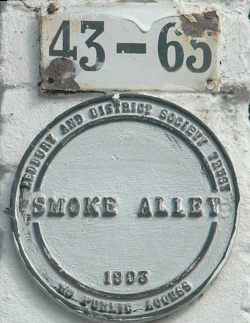
Dating from the eighteenth century the houses here were built by Richard Hatton (1747-1813) whose son, William, built Ant's Nest, for more on him click here.
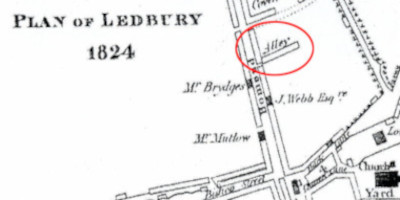
This map of 1824 shows the location, marked as just 'Alley'.
Consisting of 11 humble tenements in a rural setting they may have been desirable at the time but were too small for today's needs.
Known as Smoke Alley by 1841 some were up for sale as part of a large auction of Homend properties in 1841.
From the Hereford Journal of April 7 1841:
Lot 6: Two COTTAGES, situate in an Alley called Smoke Alley, in the Homend street aforesaid, in the occupation of Sarah Webb and Hannah Sandy. Lot 7: Two COTTAGES, situate Smoke Alley aforesaid, in the occupation of Henry Walters and Thomas Treherne. Lot 8. Two COTTAGES, situate Smoke Alley aforesaid, the occupation of Christiana Floyd and John Webb.
11 households living in a very confined space inevitably leads to friction as this extract from the Hereford Times of January 17 1846 shows:
Smoke Alley. We beg to call the attention of Superintendent Shead to tbe shameful rows which, daily and nightly, are now taking place this beautiful locality. Rows shocking to be heard, with language the most filthy, disgusting, and dreadful description made use of, to the great annoyance of the respectable parties who have the misfortune to live within hearing of them. We are in the frequent habit of calling on a friend whose house, unfortunately, is too near this sink of vice, and the rows and dreadful language we have heard is beyond all description. In the locality alluded to there is a nest of partridge which much requires to lie undisturbed. Amid all the din of about a dozen men's and women's tongues going at the same time, the voices of the old cock and hen may be heard above all. We have heard that some of these parties are about apply to the magistrates for justice tho. others hope the magistrates will do them all justice, by binding them all over to keep the peace.
Hard to imagine a nest of partridges there today!
This map of 1894 shows the location in relation to the Horse Shoe Inn which, of course, exists today.
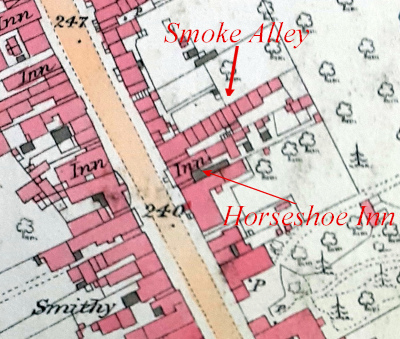
Tilley's Almanack for 1911 lists this section of the Homend thus:
35 Hill Charles H Abbey Cottage.
Ballard J E Abbey House.
Abbey House School Miss Ballard.
Horse Shoe Inn.
Here is Smoke Alley.
67 Jones Miss Shopkeeper.
69 Webb Mrs A
As it doesn't list every Homend House number this is not too helpful in determining how many cottages were in the Alley. Fortunately the 1910 survey and the 1911 census both show there were 11 cottages there.
Here are the results:
| Occupier/age | Occupation | Owner | No. of rooms |
|---|---|---|---|
| William Holtham 67 | Labourer | Misses Harrington | 2 |
| William Protheroe 57 | Labourer | Misses Harrington | 3 |
| John Hale 77 | Chimney Sweep | J E Ballard | 3 |
| Francis Davies 55 | Labourer | J E Ballard | 3 |
| Thomas Mold 68 | Labourer | J E Ballard | 3 |
| Mary Lancett 76 | Pensioner | J E Ballard | 2 |
| Charles Treherne 59 | Farm Labourer | J E Ballard | 2 |
| Charles Webley 30 | Labourer | J E Ballard | 2 |
| E Cooper 49 | Labourer | J E Ballard | 3 |
| James Morris 25 | Labourer | Misses Harrington | 2 |
| John Webley 57 | Labourer | Misses Harrington | 2 |
The Misses Harrington were two unmarried sisters living in Bank Crescent, Sarah Jane, (1861-1921), and Catherine Martha, (1872-1931) daughters of Henry & Elizabeth. John Edy Ballard, (1842-1911) the son of Thomas and Ann was living in Abbey House, Homend.
The cottages must have been very small and would have had a shared toilet and water pump.
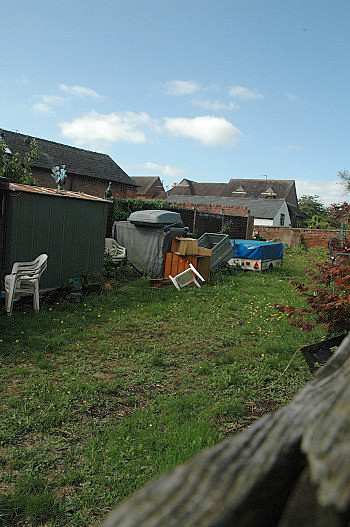
With one exception they were all demolished by 1965, the last cottage in 1969 leaving this scene today.
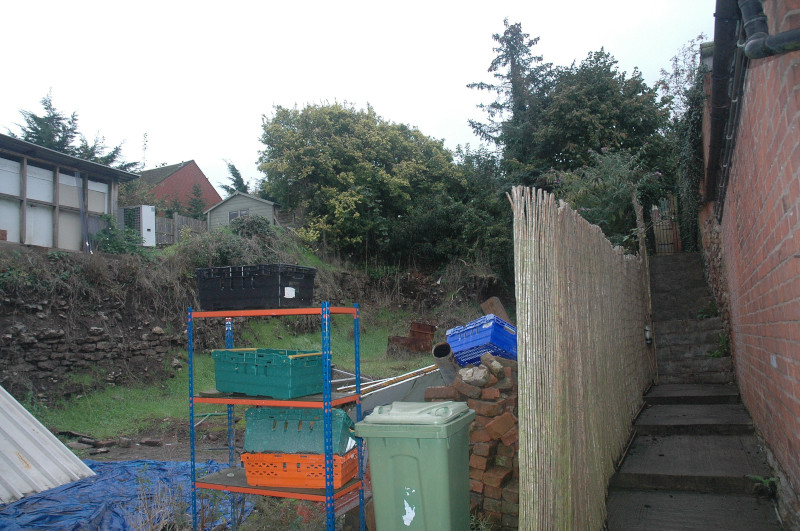
Smoke Alley today.
The steps on the right lead to No 39, which was never part of Smoke Alley. Access to this cottage, known as Horseshoe Cottage, used to be on the right hand side of the Horseshoe Inn hence the cottage's number 39.
Common Garden
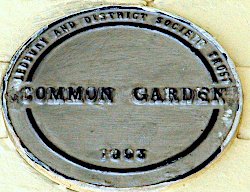
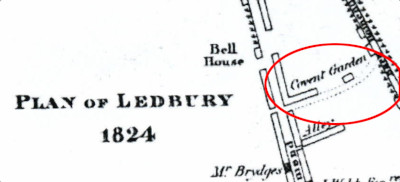
This map of 1824 shows the location, marked as Covent Garden. As with Smoke Alley this area was also built in the eighteenth century by Richard Hatton (1747-1813)
The alley was, and is, a thoroughfare path from the Homend to Back Homend (now Homend Crescent).
Tilley's 1911 Almanack lists this section thus:
Homend No 83 Sandford C.
Homend No 85 Payne E.
Here is Common Garden.
Homend No 119 Lancett C.
Homend No 121 Shinn Y.
This tells us that there were 16 houses (Odd Numbers only) here and both the 1910 survey and the 1911 census confirms this.
In the 1911 census it is easy to trace the enumerator's route. He walks down the Homend and when he reaches the alley records Common Garden premises first before listing Well Yard and returning to the Homend.
Common Garden.
| Occupier/age | Occupation | Owner | No. of rooms |
|---|---|---|---|
| Samuel Thomas Perry 51 | Pedlar | William Crockett, Bromyard | 3 |
| Jane Morris 17 | William Crocket, Bromyard | 2 | |
| George Hackett 59 | Farm Labourer | William Crockett, Bromyard | 2 |
| Mary Ann Evans 48 | William Crockett, Bromyard | 2 | |
| John Heath 54 | General Labourer | William Crockett, Bromyard | 2 |
| George Lancett 21 | Farm Labourer | William Crockett, Bromyard | 2 |
| Henry Fletcher 33 | General Labourer | William Crockett, Bromyard | 2 |
| Eliza Fleetwood 69 | Misses Harrington | 2 | |
| William Lloyd 56 | Farm Labourer | John Haines Homend | 2 |
Well Yard.
| Occupier/age | Occupation | Owner | No. of rooms | Henry Gulliford 32 | Bootmaker | John Haines Homend | 2 |
|---|---|---|---|
| Harry Sparks 30 | Farm Labourer | John Haines Homend | 2 |
| George Coley 42 | General Labourer | John Haines Homend | 2 |
| Mary Ann Walters 72 | John Haines Homend | 2 | |
| Charlotte Grifiths 60 | John Haines Homend | 2 | |
| James Hankins 42 | Hostler | William Crockett, Bromyard | 2 |
| Joseph Fletcher 26 | Farm Labourer | William Crockett, Bromyard | 2 |
In the 1911 census the Householder fills in the form including the address (usually saying Common Garden). The Enumerator adds his understanding of the address on another page and in every case with Common Garden he, the enumerator, uses the term Covent Garden. It is safe to say Common Garden and Covent Garden are one and the same.
William Crockett (1836-1912) was a Glover in New Street Ledbury in the mid C19. By 1911 he was landlord of the Garibaldi Inn Worcester.
John Haines (1856-1922) was a chimney sweep with a large family in 123 Homend.
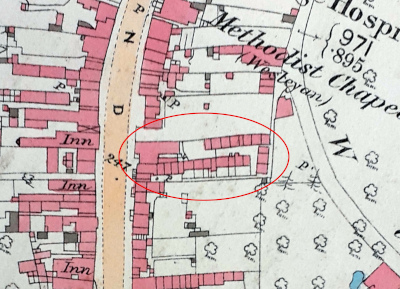
This map from 1894 shows the location in relation to the old Methodist Chapel. The alley can be found next door to Isaac's shop in the Homend
They were all demolished by 1955. Today some houses, known as Common Gardens, have been built near Homend Crescent. The lower part of the site is shown here.
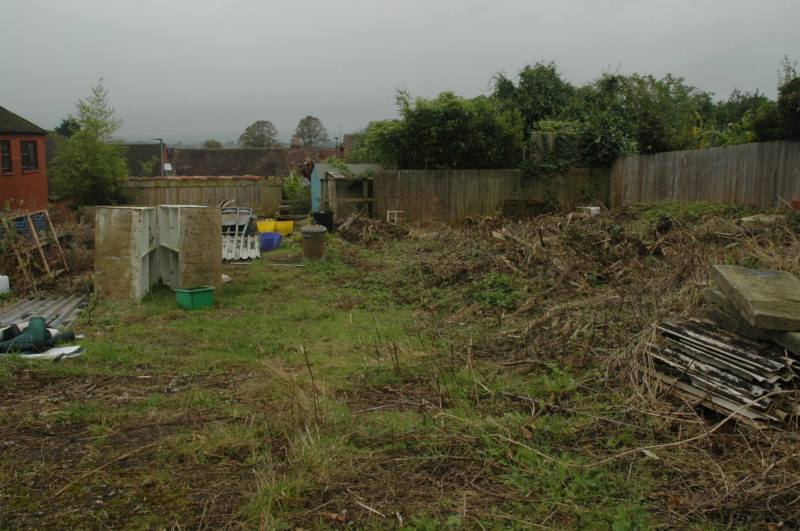
Common Garden today
Bill's Yard
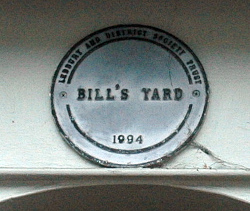
Here is Tilley's 1911 listing:
123 Haines & Son Chimney Sweepers.
133 Barnett W.
Here is Bill's Yard.
135 Merritt F. Bootmaker
137 Morris G Butcher.
The numbers 125 to 131 were allocated but covered an empty plot.
Although there is continuity in the house numbering there are two cottages associated with No 133 or 135 in Bill's Yard.
| Occupier/age | Occupation | Owner | No. of rooms | Address |
|---|---|---|---|---|
| William Barnett 33 | Ale & Stout Bottler | John Haines | 3 | 133 Homend |
| Thomas Carless 37 | Groom | Elizabeth Watts | 3 | Bill's Yard |
| George Daniels 31 | Platelayer | Elizabeth Watts | 3 | Bill's Yard |
| Frederick Merrett 47 | Bootmaker | Elizabeth Watts | 5 | 135 Homend |
Elizabeth Watts was the wife of William Watts, a Boot Maker, who was in No 135 Homend in 1909. He then moved to his native Devon
Bill's Yard is never mentioned in previous censuses so who was Bill?
Confusingly there are two candidates:
1 William Barnett who lived in No 133.
2 William Watts, whose wife owned No 135 and the extra cottage.
William Barnett (1858-1939) was Ledbury born and bred. He married Bertha Watkins in Ledbury in 1900 and they had 6 children the last in 1917 when he was a private in the Liverpool Labour Battalion during WW1.
Always a labourer he is unlikely to have any claim to the title of Bill's Yard.
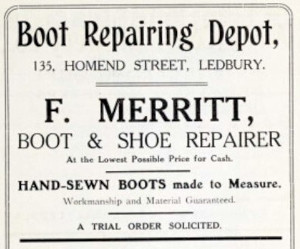
William Watts, b 1853, a bootmaker, was only here a few years from about 1904 until 1910 when he moved to Honiton, in fact he was never anywhere for long. Nevertheless he was (or his wife was) able to purchase the property.
He was succeeded by Frederick Merritt as this advert from 1911 Tilley's shows. Perhaps as a 'Depot' a yard was needed.
The Brickyard
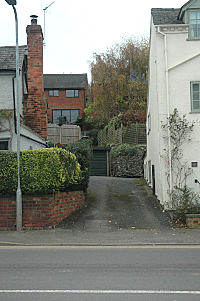
This yard does not have a plaque perhaps as there is nothing to fix it to. This image shows the former access from the Homend.
Here is Tilley's 1911 listing:
161 Underwood W Fishmonger.
163 Greenway J.
Here is The Brickyard.
183 Davies Mrs.
185 Lambert Mrs.
This gives 9 houses in the Brickyard .
| Occupier/age | Occupation | Owner | No. of rooms |
|---|---|---|---|
| Albert Fleetwood 55 | Railway Labourer | W. Martin Upper Hall | 3 |
| James Williams 58 | General Labourer | W. Martin | 3 |
| Charles Summers 54 | General Labourer | W. Martin | 5 |
| John Smith 49 | Woodman | W. Martin | 4 |
| James Wiggins 46 | Farm Labourer | W. Martin | 4 |
| James Williams 24 | Plumber | W. Martin | 2 |
| Elizabeth Sandford 69 | W. Martin | 2 | |
| Eliza Lucy 81 | Charwoman | W. Martin | 2 |
| Caroline Meredith 68 | W. Martin | 2 | |
The Martins, of banking fame (Martins Bank eventually merged with Barclays), lived in Upper Hall. The incumbent at this time was Waldyve Alexander Hamilton Martin.
In the 1910 survey only four are said to be in the Brickyard five are in 'Backway'.
The area is recorded in the 1851 census but not shown on the 1824 map shown above so the cottages were presumably built between those dates. All demolished about 1964.
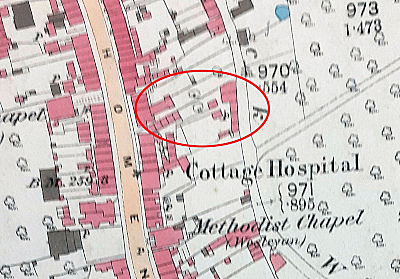
This map of 1894 shows the location with respect to the Methodist chapel and could explain why some are considered to be in Backway as those on the right do face the road called Backway at that time. This was later known as Back Homend before becoming Homend Crescent.
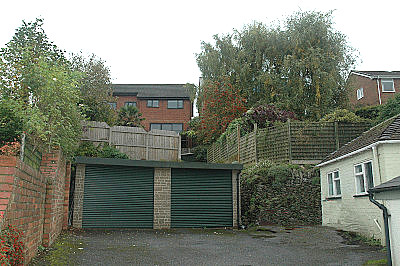
Brickyard area today
Dew's Yard
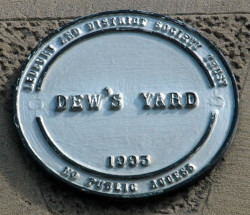
Here is Tilley's 1911 listing:
185 Lambert Mrs.
187 James Allan.
Here is Dew's Yard.
201 Barnett B.
203 Williams R.
Making 6 houses in this yard.
| Occupier/age | Occupation | Owner | No. of rooms | George Shakesheff 30 | General Labourer | Mrs Dew Union Lane | 2 |
|---|---|---|---|
| Charlotte Swift 82 | Mrs Dew | 2 | |
| William Lucy 38 | Jobbing Gardener | Mrs Dew | 2 |
| Harriett Grainger 68 | Mrs Dew | 2 | |
| Eliza Michael 70 | Mrs Dew | 2 | |
| James Barnett 78 | Retired Timber Merchant | Mrs Dew | 2 |
Note. The James Barnett in Dew's Yard was Stephen Barnett's father ( see below ).
So who was the Dew giving his name to this Alley?
There is only one Dew - Thomas - living in Ledbury in the latter half of the C19. Here is a brief history of his life, confirming his association with the Alley.
Thomas Dew was born in Ledbury in 1832 and married Caroline Browning (b 1834) in Pauntley in 1855.
They had Walter in 1860, Henry in 1863, Frances in 1865, Eveline in 1870, William in 1872 and Arthur in 1877. Living in Union Lane ( now Orchard Lane ) Thomas became a master Carpenter and joiner employing one man. He died in 1903, Caroline in 1916.
Frances married Stephen Benjamin Barnett (b 1865 Ledbury) in Hereford in 1887.Starting married life in Ledbury they had Frances in 1888, Evelyn Vesta in 1890. Moving to Brecon they had five children.: Gwenllian in 1893, Ernest in 1896, Archibald in 1900, during a spell in Coventry they had Alexandra in 1902.
When his father in law, Thomas Dew, died in 1903 the Barnett family must have moved back to Ledbury, Tilley's shows them in 201 Homend i.e. next to Dew's Yard, in 1904, where they had Dora in 1906 and Lilian in 1909. Stephen died in WW1 on Oct 29th 1918 just a few weeks before the war ended. Frances moved to her mother's house in Union Lane.
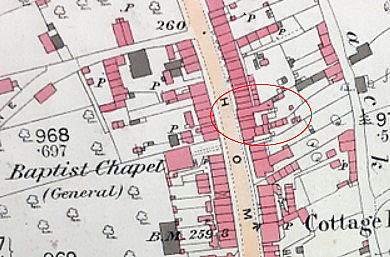
In 1955 Tilley's refers to this yard as Gable Cottages Yard but in 1960 they are no longer listed.
This 1894 map shows the area in relation to the Baptist chapel.
Ward's Row
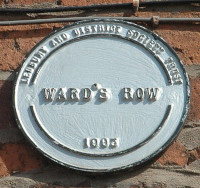
Here is Tilley's 1911 listing:
219 Smith B
Here is Ward's Row
221 Palmer C
As there is no gap in the numbering this would suggest that there are no cottages behind those facing the Homend and therefore included in the numbering .
The 1910 survey and the 1911 census tell a slightly different story.
The 1910 survey lists 5 cottages in Ward's Row but the 1911 census (which does not list empty houses) shows 4 as does a later survey in 1939.
The table below is based on the 1910 survey.
| House/No. | Occupier/age | Occupation | Owner | No. of rooms | 219 Homend | Benjamin Smith | General Labourer | A J Moss Homend | 4 |
|---|---|---|---|---|
| Ward's Row | George James 39 | Bricklayer's Labourer | Thomas Ward, Rose Cottage, Donnington | 3 |
| Ward's Row | Henry Holtham 33 | Carman | Thomas Ward | 3 |
| Ward's Row | Alfred Sandford 39 | Baker | Thomas Ward | 3 |
| Ward's Row | Benjamin Selley 60 | Labourer | A J Moss | 4 |
| Ward's Row | Arthur Parry 32 | Tractor Engine Driver | A J Moss | 4 |
| 221 Homend | Charles Palmer 58 | General Labourer | A J Moss | 4 |
Thomas Ward (1834-1916) was the son of Frances Ward, farmer, of Fair Tree Farm Ledbury. Thomas married Jessica Meek in 1864. Farming in Cradley, where they had a daughter Henrietta Alice in 1868 and a son Walter Thomas in 1871. Thomas retired by 1881 and is in Rose Cottage Donnington by 1911.
From Colwall Albert James Moss (1863-1918) married Mary Ann Barnes in 1891. After a short spell in Bradlow they settled in 217 the Homend where he is listed as a coal agent with 5 children in 1911. He died there in 1918, Mary Ann in 1935.
Always listed as a Labourer he must have done well out of the coal business as he owns all the houses from No 207 to 221 in the Homend in 1910.
Ward's Row is last listed in Tilley's in 1965.
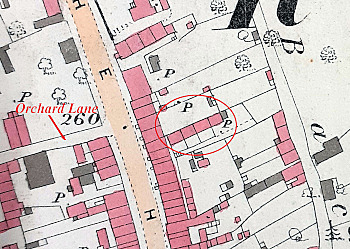
1894 map showing Ward's Row in relation to Union Lane (now Orchard Lane).
Nag's Head Yard
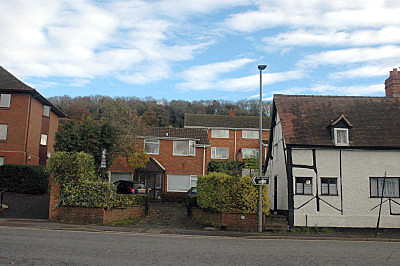
The above picture shows the location of the former Nag's Head Cottages. Easily overlooked the plaque, shown below, is on a low wall in the centre of the image. The white cottage on the right is No 235.
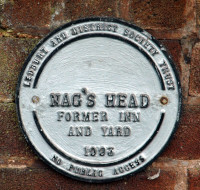
Here is Tilley's 1911 listing:
235 Huish E.
Here is Nag's Head Yard
Paul G W. School House-Boy's Council School
For some reason Tilley's stops recording the House Numbers at this point and obviously this is no help in determining how many houses were there. Fortunately the 1911 survey leaves no doubt.
| House/No. | Occupier/age | Occupation | Owner | No. of rooms | 235 Homend | Edward Huish 59 | Bricklayer | E C Williams Homend | 5 |
|---|---|---|---|---|
| 237 Nag's Head Yard | Charles Walters 30 | Platelayer GWR | E C Williams Homend | 3 |
| 239 Nag's Head Yard | Ann Griffiths 64 | E C Williams Homend | 3 | 241 Nag's Head Yard | Hannah Bastow 51 | Needlewoman | E C Williams Homend | 3 |
| 243 Nag's Head Yard | Thomas Brydges 73 | Jobbing Gardener | E C Williams Homend | 3 |
Usually in the 1911 census the occupants of side alleys do not state the Homend House Number. Fortunately here they do, including the fact that it is Nag's Head Yard.
The owner, E C Williams I can find nothing about.
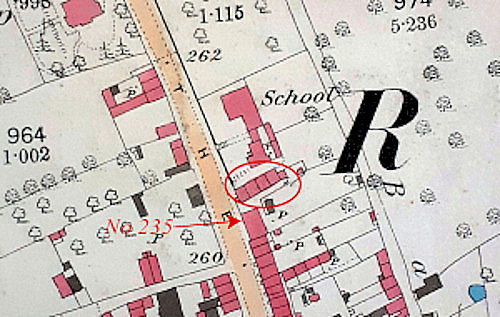
The location of Nag's Head yard can be seen on this map of 1894. The cottages consisted of a row at right angles to the Homend
Tilley's stops listing the Yard in 1965 when the house seen today was built.
Some history:
There is a mention of Nag's Head Cottages in Biddulph papers dated 1773
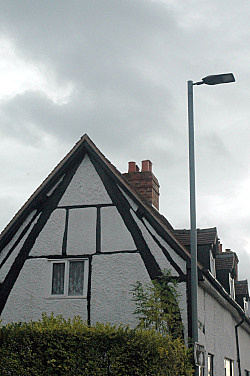
This picture of the end of No 235, formerly the Nag's Head, shows it is of "Cruck" construction.
Cruck is the term applied to a pair of curving timber members that meet at their tops to produce a rough arch. A popular construction method in the C12, it continued to be used until the C18. This house, and its cottages, must have existed in splendid isolation in the C17/C18.
If you look closely at the 1894 map above you will notice that Union Lane, now Orchard Lane, does not meet the Homend opposite Nag's Head as it does today. The original line of the lane can be seen on the ground as a side road to various properties just by the traffic lights in the Homend.
Skipp Alley
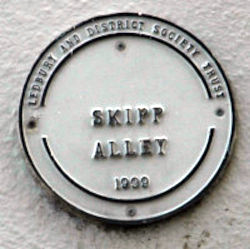
Not mentioned by Tilley's, leading only to Bye Street car park, and unnamed until about 1999.
The names of all other alleys etc. with personal names can be attributed to someone around in the early C20, this is not the case here as it is set between what was the National Provincial Bank and G. Brookes a saddler in 1910.
Who decided to name it such is unclear but we have to go back to the early C19 for an explanation.
Thomas Skipp (1771-1837) married Ann ? (1776-1851) in about 1799. They had 7 children all born in Ledbury, the baptism record in 1813 of the last, also Thomas, gives his father's occupation as Tanner.
Thomas senior died owning a lot of property in Ledbury.
Here is part of a large sale advertised in the Hereford Journal of August 9th 1837:
For Sale by auction, By ROBERT JONES, On Thursday the 24th day of August, 1837, at the New Inn, in Ledbury, at Three o'Clock in the afternoon, in the following lots, and subject to conditions of sale then to be produced, by direction of the trustees of the late Mr. Thomas Skipp, deceased.
Lot 1. A BRICK BUILT HOUSE and PREMISES, situate on the west side of the Homend Street in the Town of Ledbury, in the occupation of Frederick Bowkett, Brazier and Tinman; comprising a large sale shop and parlour in front, with cellar underneath; kitchen, back kitchen, yard, workshop, &c. at back; 4 bed rooms on the chamber and 3 on the attic storey.
Lot 2. A HOUSE and PREMISES, adjoining Lot 1, in the occupation of Mrs. Skipp of the same size, and comprising the same number of rooms and other conveniences as Lot 1.
Lot 3. One other HOUSE and PREMISES, adjoining to Lot 2, in the occupation of William Bowkett, boot and shoe maker, having cellar and rooms in front, the same as Lots 1 and 2, with kitchen, yard, and work-shop at back; 2 bedrooms on the chamber and 2 on the attic storey.
The 1839 Tithe map shows that Frederick Bowkett is in what is now No 14 (Stooke, Hill & Walshe), Ann Skipp was in No 16 and William Bowkett in No 18.
So the alley is aptly named!
Scattergood's Yard
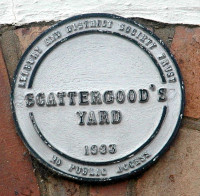
Here is Tilley's 1911 listing:
24 Sale A G
Here is Scattergood's Yard
30 Scattergood W
Showing just two numbers missing.
Usefully the 1910 survey logs 26 and 28: '2 Cottages at rear in Scattergood' Yard.'
| House/No. | Occupier/age | Occupation | Owner | No. of rooms | 24 Homend | Alfred George Sale 31 | Horse Dealer | Executors of J Baylis | 7 |
|---|---|---|---|---|
| 26 Scattergood's Yard | Jason Cowley 39 | Groom | W Scattergood | 4 |
| 28 Scattergood's Yard | William J Morton 62 | W Scattergood | 4 | 30 Homend | William Scattergood 85 | Horse Dealer | W Scattergood | 8 |
The family of Scattergoods William, b 1793, and his wife Mary, b 1803, moved to Ledbury from Worcester shortly before 1841 and settled in New Street, they had 8 children. Here we are following, William b 1825, the owner listed above, and Daniel, b 1837.
Daniel Scattergood married Sophia Brant in Kings Norton in 1861 and is in Church St in 1861 as a butcher. They had one son, Daniel Thomas. Sophia died in 1862 and Daniel remarried to Elizabeth Jeffs in 1871.
In 1871 Elizabeth is in the Homend at Scattergood's Yard, listed as Wife to Head of Household. (Daniel must be away on business). With her is her brother in law William described as an Ironmonger (out of business). He had been in New Street, see New Street South page.
In this 1871 census Scattergood's Yard is listed showing occupiers of the two cottages as John Griffiths 64 and Edward Farmer 22 both of Ledbury. There is no suggestion of these cottages in 1861 and as Daniel was in Church Street in 1861 it seems reasonable to assume the cottages were built between 1861 and 1871.
By 1881 Daniel, now a Horse and Cattle Dealer, is in Bridge Street and William is in the Homend property, listed as a Horse Dealer, with Mary Elizabeth his wife. She died in 1891, William in 1912.
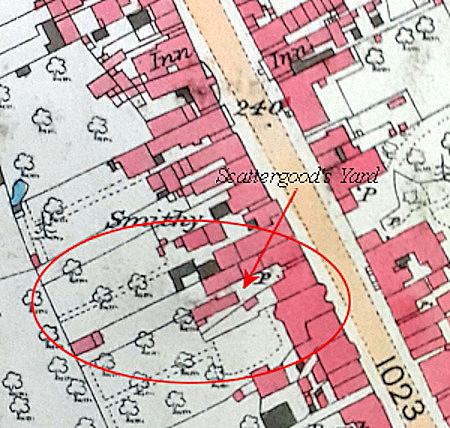
The location in 1894.
These cottages are listed, the citation reads:
No 26.
(At rear of No 30) C18 brick. New tiled roof with gabled end and 2 large new gabled dormers. 1 storey and attic. 2 modern casements in segmental headed openings, segmental headed doorway with modern glazed door. Interior: said to contain C18 fireplace with moulded surround.
No 28
(At rear of No 30)Late C18 cottage. Red brick. Slate roof with coping to gable ends. 2 storeys. 2 windows. Segmental headed 3-light casements. Central panelled door with new plain hood.
Hodge's Yard
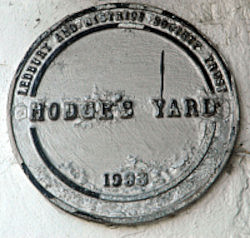
Here is Tilley's 1911 listing:
50 Hodges Mrs W. baker &c
Here is Hodge's Yard
62 Faherty J P Wool & Fancy
64 Hollings J
Fox Inn
This suggests 5 cottages and that No 62 is not in Hodge's Yard but an old sign above the entrance says otherwise.
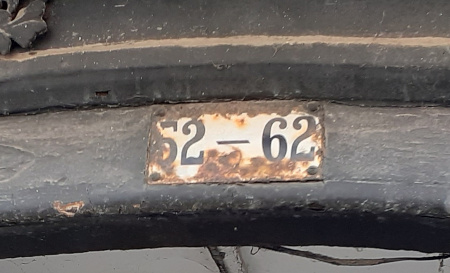
From the 1910 Survey:
| House/No. | Occupier/age | Occupation | Owner | No. of rooms | 50 Homend (Now The Codfather) | Caroline Hodges 50 | Baker & Grocer | Mrs C Hodges | 7 |
|---|---|---|---|---|
| 52 Hodge's Yard | Rose Moss 37 | Mrs C Hodges | 3 | |
| 54 Hodge's Yard | Mary Hughes 60 | Mrs C Hodges | 3 | |
| 56 Hodge's Yard | Thomas Preece 34 | General Labourer | Mrs C Hodges | 3 | 58 Hodge's Yard | Thomas Williams 43 | Bricklayers Labourer | Mrs C Hodges | 4 |
| 60 Hodge's Yard | Emma Symonds 66 | Mrs C Hodges | 3 | |
| 62 Hodge's Yard | May Louise Faherty 42 | Fancy Draper & Dress Maker | Mrs C Hodges | 5 |
| 64 Homend | James Hollings 38 | Execrs of J Baylis | 5 | |
| Fox Inn (Now Raduni) | James Hollings 38 | Innkeeper | Execrs of J Baylis | 5 |
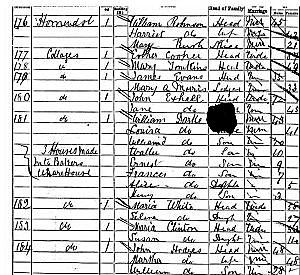
As this extract from the 1881 census shows there must have been at least 8 cottages before that date as the enumerator lists '3 houses made into bakers warehouse'.
Note the John Hodges 48 at the bottom of the page and his son William 28 a baker.
As shown in the table above this yard is just a few doors from the Fox Inn and this extract from the 1871 census, again just a few doors from the Fox Inn, shows that the yard was called Gurney's Yard at that time.
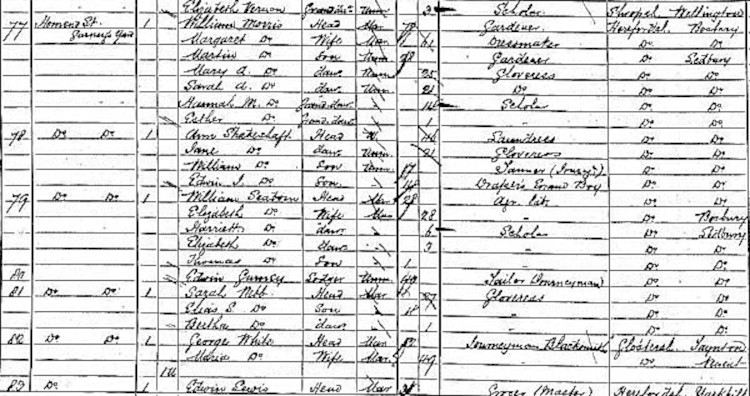
So who were the Hodges?
John Hodges (1832-1908), a carpenter, and Martha Kent (1832-1900) lived an unconventional life. They are together in Bye Street in 1861 with a son William Kent b 1852 and a daughter Mary Jane Kent b 1857. The baptism's of both children state that they are children of a spinster!. For more on what happened to Mary Jane see Fox Lane below.
(Martha, b Deerhurst January 1832, is a dressmaker in Bye Street in 1851 as a visitor to a family called Stephens). In 1871 William is apprenticed to John Powell, a Master Baker, in Widemouth St Hereford and by 1881 the family are established in Hodges Yard where William is shown as a baker. Remember this is the census where the enumerator says 3 cottages have been turned into a Baker's Warehouse.
As William Kent Hodges, William married Caroline Allen in Ledbury in 1893 and they had a daughter Kathleen Anne in 1895. Sadly he died in 1900 as this report in the Hereford Times of May 19 1900 shows:
Death of MR. WILLIAM HODGES.
Mr. William Hodges, baker and confectioner, of Homend Street, passed away early on Monday morning. Deceased had been ailing for the past twelve months. and since October had been constantly attended by the doctor. Deceased, who made many friends by his kindly and amiable nature, leaves a widow and a little daughter aged five years to mourn his loss.
He was just 48.
Caroline carried on with the bakery business being described as a baker, confectioner shopkeeper in 1901.
Kathleen married Roland Edward Osborne of Leigh on Sea in Ledbury in 1927, and Tilley's lists Caroline in No 50 until 1930 when R B Gabb takes over the business.
He was here until about 1950 when it became Merrits seed merchants followed by G E & B M Cole, greengrocers and then a chip shop in the late 1990s, now The Codfather Part 11.
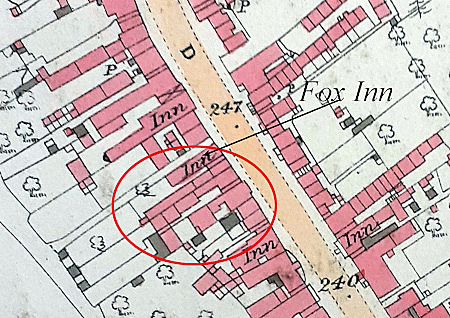
The location in 1894.
The cottages remaining are listed, here is the citation:
Nos 52 to 58 (even).
(Situated behind No 50).C17 timber framed with brick infilling. Tiled roof with gabled ends. 2 storeys and attic. West elevation casements outshut and passageway through, inside of passageway are doors to No 54 and 56 with moulded architraves with cornices, No 56 with fielded panel door, the end of the passage has elliptical wooden arch with keyblock and cornice. Wing on east is No 58, timber framed, ground floor faced in C19 brick.
Fox Lane
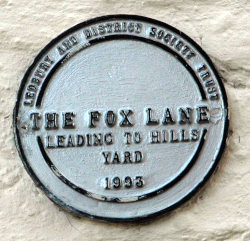
The Fox Inn (now Raduni) can be found listed in a 1793 Directory. In 1891 John Hollings was landlord and it remained in the same family until 1962 followed by B J Thomas until it closed in about 1967. It is No 68 Homend.
No 70 Homend, i.e. the other side of the lane, is owned by George Hill (occupied by John Jones), and is described in the 1910 survey as House, Stable & Premises.
I can find no suggestion that anyone was living in this yard in the C20 but the 1871 census does show Fox Inn ( landlord William Drayton) and 4 cottages in Fox Yard.
Other censuses show a similar street listing but do not refer to Fox Yard making it difficult to say when the cottages went.
Here is the 1871 census:
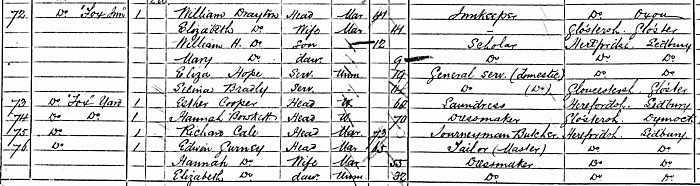 The reference that George Hill had a yard here is somewhat tenuous perhaps it was at the back of No 70, Tilley''s later describes the Lane as Hill's Timber Yard.
George Hill, (1854-1940), married Mary Jane Kent/Hodges in 1880 (she was the sister of William Hodges whom Hodges Yard is named after), and they had 4 children. Mary Jane in 1884, John in 1887, Ellen Margaret in 1890 and Thomas Henry in 1893. Mary Jane married Arthur Ford of New Street in 1907.
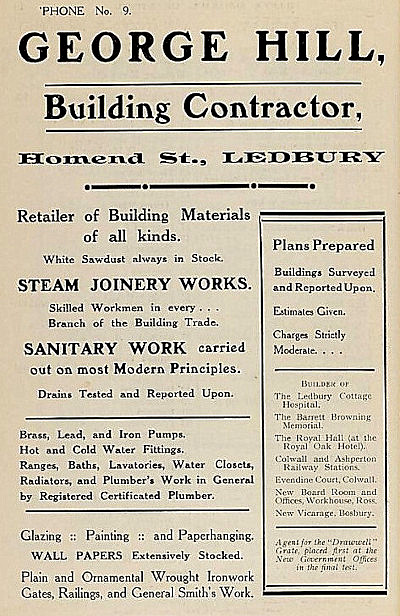
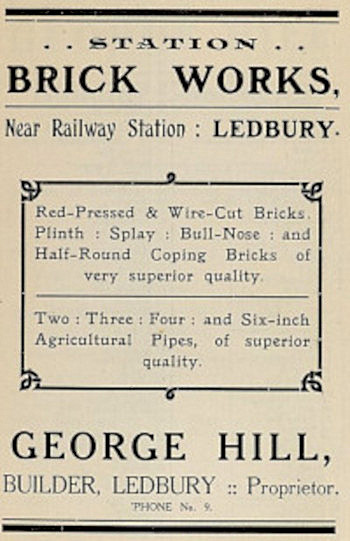
A reputable builder it seems he built most of Ledbury including the Cottage Hospital and the Barret Browning Institute. He lived in Nos 40 & 42 Homend described as House, Stables, Workshop, Land & Buildings in 1910, now part of The Olive Tree.
Thorne's Place
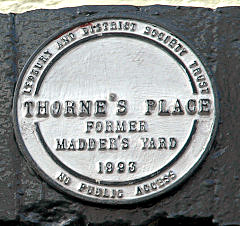
The entrance to the alley from the Homend is between No 84 and 86 but only goes to the back of No 84.
Thorne's hairdessing, established in 1947, is situated in No 84 Homend. Madders was, for many years, a well known grocers in No 86.
The history of No 84 should be the history of the Place or Yard.
Tilleys has this in 1911:
82 Robinson W
84 Baggott Miss
86 Madders W & Sons. Grocers.
Note all the following lists are shown going from the former Plough Inn toward what was the Cottage Hospital.
From the 1910 Survey:
| House/No. | Occupier | Description | Owner | 82 Homend | W Robinson | Shop & Premises | Wm. Madders |
|---|---|---|---|
| 84 Homend | Miss Baggott | Shop & Premises | Wm Madders |
| Wm. Madders | Warehouse | Wm.Madders | |
| C Orpwood | House & Premises | Wm. Madders | |
| 86 Homend | Wm. Madders | Shop & Premises | Wm. Madders |
| 88 Homend | Wm. Madders | Shop & Premises | Wm. Madders |
| 90 Homend | Wm. Madders | Shop & Premises | Wm. Madders |
There were two properties behind No 84, one used as warehouse by William Madders and one occupied by C Orpwood.
The 1911 census lists:
| Occupier | Age | Occupation | No of Rooms | Address | William Robinson | 32 | Butcher | 5 | Homend |
|---|---|---|---|---|
| Mary Ann Baggott | 64 | None | 6 | Homend |
| William Williams | 36 | Bricklayer | 3 | Homend |
| Caroline Orpwood | 73 | None | 3 | Baggotts Yard |
| Henry Christopher | 60 | Railway Plate Layer | 5 | Homend |
The two cottages were occupied at this time by William Williams and Caroline Orpwood
From the 1911 census:

NB This entry was probably not written by Caroline and was entered 'as heard'. She appears as Catherine Orpwood in the Homend in 1891 married to George and died as Catherine Orpwood in 1916 but it does show that 'Caroline' is in a 3 room cottage in 'Baggots Yard' and the next entry, with William Williams in occupation, shows another 3 room cottage exists; both after the Baggott residence, No 84.
The pattern is repeated in earlier censuses with the 1871 census being particularly interesting:
| Occupier | Age | Occupation | Address | Joseph Cale | 29 | Butcher | Homend |
|---|---|---|---|
| William Smith | 44 | Postman | Homend |
| Robert Baggott | 77 | Glover | Homend |
| Charles Langford | 57 | Brewer | Homend Baggotts Yard |
| John Carter | 30 | Stable Man | Homend Baggotts Yard |
| Edwin Jones | 53 | Currier | Homend |
Extract from the 1871 census showing the Baggotts Yard entry in the Homend.
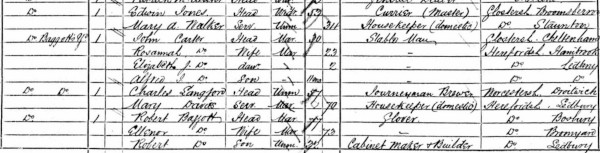
From all the above it is certain that there were two cottages at the the back of what is now known as Thorne's Place and it was once known as Baggott's Yard.
The Baggots were living in No 84 from at least 1851.
Robert Baggot, senior b. 1789, is here in the 1851 census as a Fell Monger ( a dealer in hides or skins, particularly sheepskins, who might also prepare skins for tanning), with his wife Eleanor and 7 children, Robert b 1820, Harriett b 1823, Olive b 1825, Edwin b 1827, Emma b 1828, Penelope b 1830 and Mary Anne b 1832. Robert senior died in 1872.
After he died his eldest son, also Robert, a cabinet maker, became head of household in later censuses living with his single sisters Penelope and Mary Anne, there are always two cottages listed next to them. Penelope died in 1904, Robert junior in 1906 leaving just Mary Anne who died in 1918, she is the Miss Baggott referred to in Tilley's Almanack.
J Webb, hairdresser, is here from 1920 to 1947 when Thorne's Hairdressers is established by Emrys Thorne.
White Horse
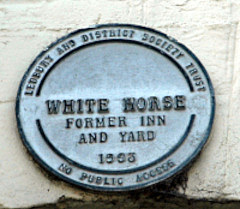
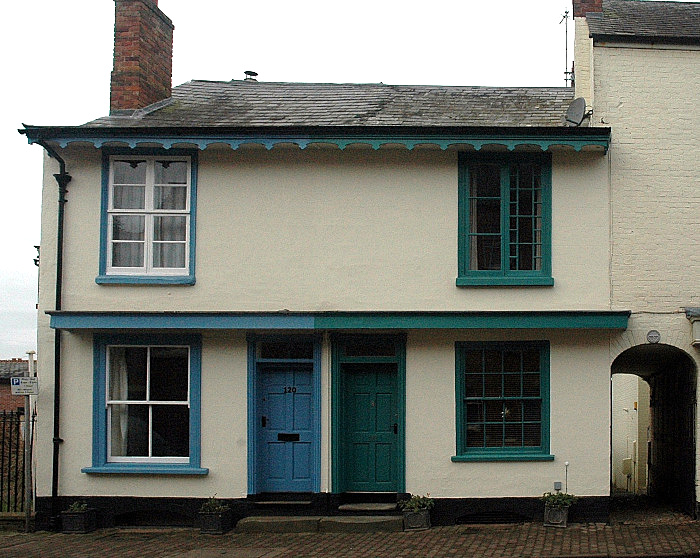
The above image shows No. 120 on the left and No. 122, the White Horse, on the right.
As pubs go this Inn was quite small consisting only of No 122.
These two buildings are English Heritage listed together, here is the citation:
Early C19. Stuccoed. Slate roof with gable ends, and deeply projecting eaves with shaped frieze. 2 storeys. 2 windows. 1st floor casements with glazing bars (No 120 altered). Ground floor sashes with glazing bars in moulded casing. 2 central doors in moulded doorcases with rectangular fanlights, No 122 has panelled door. Continuous pentice hood over ground floor.
Known as the Pack Horse Inn in the early C19 with Benjamin Bennett as landlord in 1851 followed by William Barnes in 1861. Renamed as the White Horse Inn by 1871 with William Jackson as landlord.
From 1881 William Banks (1825-1898), and his wife Elizabeth, b 1818, hold the licence she died in 1906.
In 1911 James Jones 40 is licensee and the inn closed its doors in 1930, becoming the Employment Exchange for a few years then a private house.
Bowler's Yard
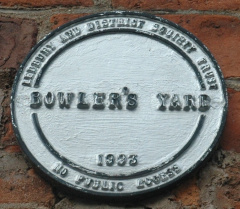
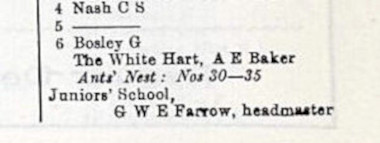
An integral part of No 15 Church Street, formerly the White Hart, it was named after Samuel Bowler but has a lot of history as Hatton Gardens.
Samuel Bowler (1813-1892) was the son in law of William Hatton, a builder, (1777-1852). This is not the place to go into the full family history which can be found in the William Hatton section of the Ledbury People page here.
Living here from at least 1844 he (William) must have built 8 cottages in his back garden. These are referred to in his will dated 1846 when he leaves 'eight cottages with a garden and shed attached to each now in the respective occupation of Thomas Stephens, Charlotte Bailey, Ann Waite, Thomas Davis, John Meredith, William Colwell, Joseph Bowkett and Benjamin Jenkins with their appurtenances to the use and intent that my wife Ann Hatton' may benefit from the income.
Most of the names mentioned in the will can be found on the 1851 census and are listed before No 15 when walking up from the High Street i.e. just prior to the White Hart.
This pattern is found in 1861 and 1871. In 1881 the cottages are shown as Bowler's Yard but in the 1910 survey, shown below, they are listed, historically correct, as Hatton Gardens.
| Occupier | Owner | Description | Address | S H Bowler | S H Bowler | House & Premises | 6 Back Lane |
|---|---|---|---|
| Mrs E A Gurney | Mrs Eliz. Gurney | House & Premises | Hatton Garden |
| Edward Smart | Miss S H Bowler | House & Premises | Hatton Garden |
| Miss Watts | Miss S H Bowler | House & Premises | Hatton Garden |
| M A Bosley | Miss S H Bowler | House & Premises | Hatton Garden |
| C Treherne | Miss S H Bowler | House & Premises | Hatton Garden |
| Chas Hill | Miss S H Bowler | House & Premises | Hatton Garden |
| A Taylor | Miss S H Bowler | House & Premises | Hatton Garden |
| Elizabeth Gurney | Mrs Eliz. Gurney | White Hart Inn & Premises | Back Lane |
NB Back Lane was renamed Church Street at about this time.
And the 1911 census shows the no of rooms - they were small.
| Occupier | Age | Occupation | No of Rooms | Listed Address | Sarah Hatton Bowler | 71 | Smock Weaver | 6 | 6 Church Street |
|---|---|---|---|---|
| Charles Summers | 32 | GWR Platelayer | 2 | 9 Church Street |
| Edward Smart | 30 | GWR Platelayer | 2 | Church Street |
| William John Smith | 23 | GWR Platelayer | 2 | Church Street |
| John Bosley | 75 | None | 2 | 13 Church Street |
| Mary Ann Taylor | 84 | None | 2 | 14 Church Street |
| Elizabet Ann Gurney | 72 | Beerhouse Keeper | 10 | White Hart Church Street |
This shows just 5 houses between 6 Church Street and the White Hart (No 15) - unoccupied houses are not listed.
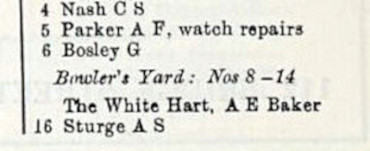
The last of Bowler's Yard cottages must have been pulled down by 1968 as Tilley's has the listing on the left for 1967 and on the right for 1968.
Salter's Yard
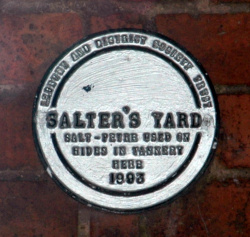 Salting an animal hide is the first process in making leather and it is surely no coincidence that this Salter's Yard was close to the cattle market and the Butcher's Row in the High Street where animals would have been slaughtered.
The raw skins were first "cured" by salting them promptly after being removed from the animal by being liberally covered in salt and left for about 30 days before being removed to the Tannery in Church Lane where a water supply was available for the next process.
This area was owned by Benjamin Mutlow in 1839 and more can be seen about him in the Mutlow section of the Ledbury People page here. He died in 1863.
Chapel Alley
A small, cramped, timbered chapel tucked away down an alley was certainly here in 1785 as baptism records exist from that date.
In 1841 the Minister in charge was John Grey (1782-1846) and he must have been here by 1806 as this report of his death in the Hereford Journal of November 11th 1846 shows:
Nov 8th at Ledbury, in the 64th year of his age, regretted by all who knew him, after a long and severe illness, borne with Christian resignation to the Divine Will, the Rev. John Grey, for upwards of 40 years the faithful Minister of the Independent Congregation in that town.
Various records show he was living in Horse Lane (Worcester Street). He married Sarah (probably Hawes) and they had Harriett in 1809, Ann in 1811, Edward Francis in 1814, John in 1816 (died 1816) and Sarah Hawes in 1818, all in Ledbury. His wife, Sarah b 1788, died in Ledbury in 1837. As already stated the Rev Grey died in 1846.
The Rev. John Averill was Minister from 1850 to 1853. A young man, born in 1828, he seems to have been a bit controversial. He left his previous appointment at Kingsbridge, Devon, in April 1850 after just eight months and appointed to Ledbury later that year as is shown in this report from the Hereford Times of December 17th 1853:
Ledbury. On Thurday se'nnight, (a week) a numerously attended and respectable meeting of the members and friends of the Independent body of Dissenters, assembled at the George Assembly Room, in this town, to present to their esteemed pastor, the Rev John Averill, a testimonial of respect upon the occasion of the resignation of his ministry. The invitation to Mr. Averill to a farewell soiree was spontaneously made by the majority of the members of the Church over which he had for three years so ably and zealously officiated......My underlining.
Later appointments show he was never anywhere for long, nevertheless we have to thank him for the handsome building seen today.
A report in the 'Patriot' of August 16th 1852 shows work has started:
INDEPENDENT CHAPEL, LEDBURY, HEREFORDSHIRE.And the grand opening on September 15th 1853 was recorded in the same Journal:
We are glad to observe, that the friends of the Rev. John Averill have commenced the building of their new chapel in that town. The old place of meeting had become so old and inconvenient, and afforded such insufficient accommodation for those desirous of worshipping there, that a new one was indispensable, and therefore resolved upon. The old chapel, built two centuries ago, would only seat 120 persons whereas, the new one will accommodate about 400....The church is revived and the congregation increasing....
NEW CONGREGATIONAL CHAPEL, LEDBURY, HEREFORDSHIRE.
This beautiful and substantial place of worship was dedicated to the service of Almighty God on Wednesday, August 31. Two excellent and very appropriate sermons were preached by the Rev. G. Smith, of Poplar. Dinner and tea were provided by a Committee of ladies: about 100 sat down to the former, and 200 to the latter. After dinner, addresses were delivered by the Revs. J. Averill (pastor), G. Smith, and H. J. Chancellor. Mr. Smith, in an admirable address, commented on the pastor's allusions to the antiquity of this ancient church, to the days of fiery trial of which it had been a witness, and in which it had probably been a sufferer.............
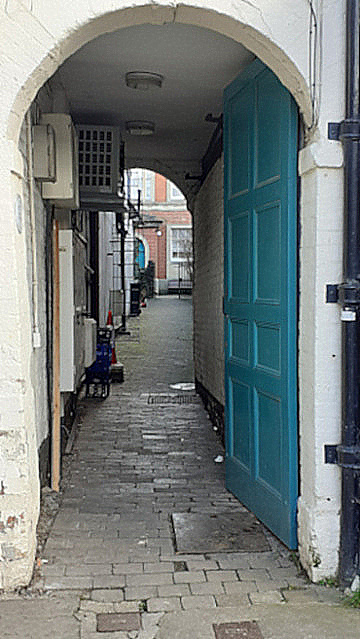
with the chapel seen at the end.
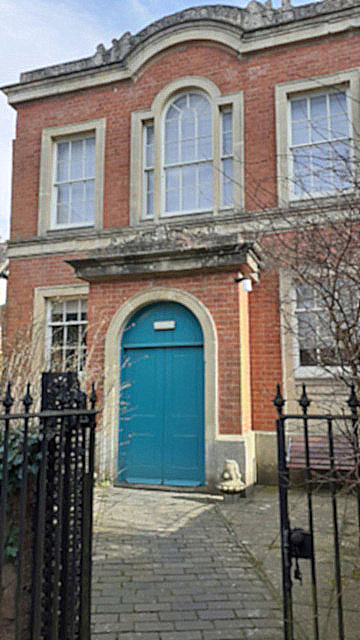
The Rev Averill didn't stay long after as this report in the Hereford Times of December 17th 1853 shows:
LEDBURY.The chapel was registered " for the solemnisation of marriages therein" on Oct 7th 1864.
TESTIMONIAL OF RESPECT TO THE REV. J. AVERILL.
On Thurday se'nnight, a numerously attended and respectable meeting of the members and friends of the Independent body of Dissenters, assembled at the George Assembly Room, in this town, to present to their esteemed pastor, the Rev John Averill, a testimonial of respect upon the occasion of the resignation of his ministry. The invitation to Mr. Averill to a farewell soiree was spontaneously made by the majority of the members of the Church over which he had for three years so ably and zealously officiated......
In 1866 the Rev C. Y. Potts was appointed pastor and remained in office until his retirement in 1907. He died on May 11th 1909.
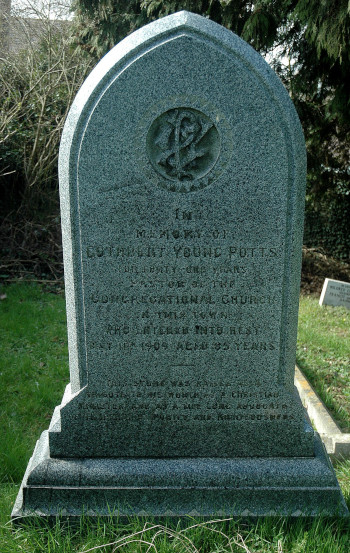
A particulary poignant point was made in the report of his funeral reported in the Hereford Times of May 22nd 1909:
"The funeral the Rev C. Y. Potts took place on Saturday afternoon, at the Ledbury Cemetery amid unique manifestations of general respect. Such a gathering of all classes and all sections of the community has seldom been seen in Ledbury. One remarkable feature was the absence of any relative, not one surviving to take part in this last solemn act of respect."
The image on the right shows the handsome memorial to him in Ledbury cemetery.
The inscription reads:
In Memory of Cuthbert Young Potts for forty one years Pastor of the Congregational Church in this town. He entered into rest May 11th 1909 aged 85 years.
This stone was raised as a tribute to his worth as a Christian Minister and as a life long advocate of temperance purity and righteousness.
He was followed by the Rev. Henry Barnes.
The new building fell into disuse and was purchased and restored by the Ledbury Civic Society by 1985.
Now known as the Burgage Hall it is available through the Society for community use .
The entrance used today is found alongside the Butcher's Row Museum in Church Lane and unfortunately the gate to this alley is often locked.
Tannery Lane
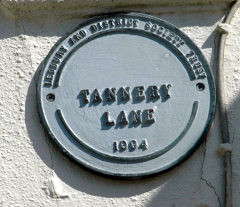
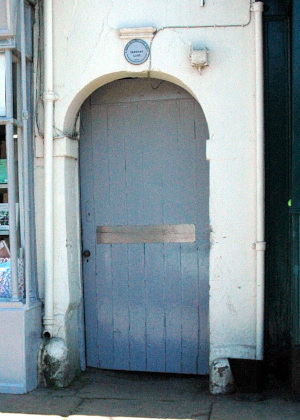
Located between the Three Counties Bookshop and The Retreat public house this alley is the Fire Exit for the pub so the gate is unlikely to be locked.
Tanning, or hide tanning, is the process of treating skins and hides of animals to produce leather, a tannery is the place where the skins are processed. Tanning by ancient methods is so foul smelling that tanneries were set back from the main streets.
Skins typically arrived at the tannery dried stiff and dirty with soil and gore. First, the ancient tanners would soak the skins in water to clean and soften them. Then they would pound and scour the skin to remove any remaining flesh and fat. Hair was removed by soaking the skin in urine. The hides were then softened by pounding dogs or pigeons dung into the skin.
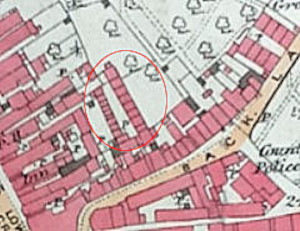
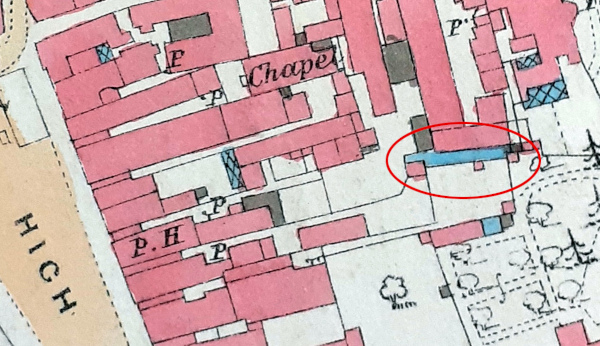
This process required an adequate supply of water and the map of 1894 shows the water supply, circled, readily available.
The finished hides were then dyed and dried in Bye Street. For more on this see here.
The tannery, (vehicular access from Church Lane then and now) was also owned by Benjamin Mutlow in 1839 (see Salter's Yard).
I cannot find out anything more about the Tannery/Yard.
The letters P.H (Public House) on the map is now The Retreat with the alley alongside it leading to the yard.
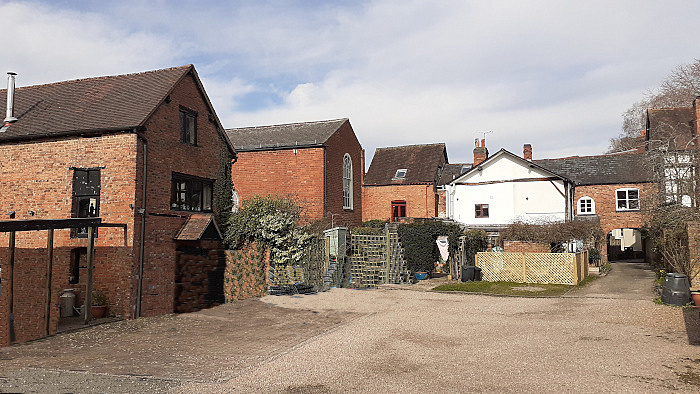
Here is the Tannery yard today.
Tilley's Alley
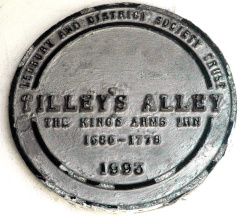
I can find no reference to 'The Kings Arms' in newspapers available on line. However the book 'The Pubs of Bromyard, Ledbury' by John Eisel and Ron Shoesmith (ISBN 1 873827 63 6) has this to say:
The King's Arms, which was a few yards down the High Street from the Bull, (now the Retreat) at Nos. 16 and 17 was an important Inn of the 18th century. However by 1773 it had fallen from grace and on 10 June the Hereford Journal advertised:
To be sold to the best BIDDER, on Wednesday the 30th instant, at the King's Arms, Ledbury, between the hours of two and six in the afternoon, according to conditions then produced, unless sold in the meantime by private trade, THAT well accustomed INN the said KING'S ARMS, together with a garden coach house, assembly room, stables, granaries, wool lofts and all other buildings........................now in the possession of John Yarnold.
NOTE The 1773 edition of the Hereford Journal is only available in Hereford Archives.
The Inn was bought by Luke Morris of the Plume of Feathers (The Feathers) opposite and closed in 1778.
Luke Tilley needs no introduction here. I have referred to him frequently and his life is comprehensively covered here. By 1896 he owned the properties on both sides of the alley and at some point established his printing works down the alley, the building still exists.
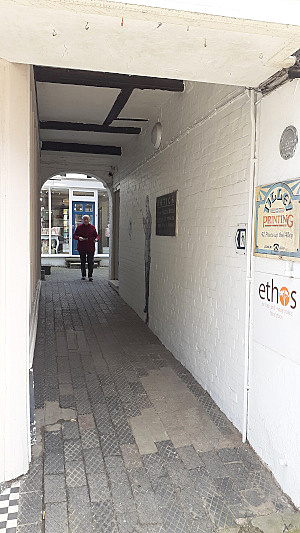
This alley is the only one that actually leads somewhere. Go down there passing several old premises and the Tilley printing building, shown below, through a courtyard with beautifully restored cottages, and you will find yourself in Worcester Road.